The Interesting World of Potty Training

The first time one of my students came up to me and told me he needed to “go sink the boat” I had no idea of what he was talking about. It took a few seconds but I finally figured out from the jumping up and down while holding his pants and body parts in a death grip that he needed to go to the boy’s bathroom. Yep, when he was being potty trained they put little plastic boats in the toilet and, well, I am sure you get the picture.  They used this approach with sons #1, 2 and 3 and it wasn’t until son #3 that I was an insider on their potty training method.  It obviously worked for them.

Before we go any farther, let me just say…I am not an expert in potty training!  Nope, not going to quote any scientific studies.  But I am going to share with you my own experiences potty training my son and daughter and I am sure they will appreciate that I don’t use their names.

My daughter, the first born, the one where  Infants and Mothers by T. Berry Brazzleton was our guide.  I am sure 31 years later much of the information in the book is out of date (i.e. babies should sleep on their stomachs) but much of what he said was common sense and understandable.  He’s written several newer books on early childhood and parenting that have receive good reviews.

Either from his book or somewhere else, I had in my mind that age 2 was the magical age to start potty training my daughter.  I actually think it had a lot to do with being sick and tired of dealing with and buying diapers but for whatever reason around age 2 we started the journey.

We bought the big girl panties together but still wore a diaper at night.  We sat countless times in the bathroom with her on the little toilet and me on the edge of the bathtub waiting for something to happen. Sometimes there would be a trickle, sometimes there wouldn’t.  We’d leave the bathroom.  She’d have an accident.  I’d do the laundry.  I spent so much time trying to anticipate when she might need to go to the bathroom.  It took the fun out of anything we were doing.

Then, while my husband was still in Korea, we took a trip to Boston to visit my cousin.  We rode the swan boats, saw the ducks, enjoyed the city and wore her out!  The next morning when I was chaining her diaper I knew she needed to go to the bathroom.  So instead of putting her in her cute, little panties, I put her on the toilet.  I was the coach making all of the grunting noises and she was making them with me.  Plop!  Success!  “Yeah, you just went potty!”  Click!  She made the connection!  Did she ever have an accident again?  Of course she did but very few.  From then on when I asked her if she had to go potty, she knew what I was talking about.  It was just like when she was sitting with her little brother “reading” him a book in the window sill.  She sounded out the word hot and came running to me to ask me if it was the word hot. I told her yes and that was the moment when reading clicked for her.  We were  both thrilled!

On to child two.  My son, the 2nd born, still had the wisdom of Dr. Brazzleton, but not all of my time.  So when it came time to think about potty training I didn’t think about it too long.  I think I had flashbacks doing it 4 years earlier and I wasn’t looking forward to that.  Lucky, for me I had read an article about not starting potty training too early, so I didn’t.  This article also said the child would just naturally potty train on their own but that isn’t practical if you want to send your child to a daycare that requires them to be potty trained.  I didn’t wait for him to potty train himself but I did wait until he was closer to age 3.  He didn’t have “aha moment” on the toilet, but I do remember he was fully potty trained in a week once we started.  Although, if I would have thought of the boat idea, I probably would have introduced it but it would have been boats cut out of toilet or tissue paper.  Seriously, is there a little boy that wouldn’t like to sink the boat?

So, what do I think about potty training?

1. Children need to be physically ready…..the muscles they will use have to be fully developed.

2.  They need to be developmentally ready.  Just like so many tasks they learn in their early years they need to have the mental readiness to understand it.

3.  They need to somehow make the the connection between the word potty and what their body is doing.  How many times do you see a toddler standing, making faces and doing the duty in their diaper?  That would be the opportune time to say to them,  “Yeah, you’re going potty in your diaper”.  Cues like that will help them make the connection later.

4.  Don’t rush it.  If you start the process and it just isn’t clicking, stop.  Wait a few weeks and try again.

5.  Don’t forget to let them flush the toilet.  Those who follow them in the bathroom will appreciate it.

6. Whatever words you chose to call using the bathroom will surface out in public.  It might be cute at 2 but could be the subject of laughs by peers at age 5.

Son #3 of the above mentioned family told me he needed “to make a frog”.  Luckily I was the only one that heard it. I wasn’t caught off guard this time and didn’t need to ask any questions!

These are my thoughts.  What are yours?
Posted in Notes from the teacher's desk | Tagged , , , , , , , , | 4 Comments

The Crying Room

I will admit it…..there are days when I don’t like some of my students.  It’s the days when they are whiney and fussy and can’t really tell me why.  By the end of the day they have worn me out!   Luckily, I get to send them home.

I remember those days with my own children……praying they would take a nap and wake up a happy child again.  Some days, that just didn’t happen.

On those days I wish I would have thought of this idea!  My daughter has a friend with a two year old that my daughter adores.  A few weeks ago she was telling me the story of the “Crying Room” and I thought it was quite ingenious and wanted to share it.  As the story goes, it was one of those days when the little girl was whiney, fussy and crying.  Mom had tried everything to get her to be her happy, little girl and it wasn’t working.  Finally, mom told her that she would have to go to the crying room (I believe it was the guest room). It worked so well that the next time she had a fussy day she told her mom she thought she needed to go to the the crying room.  I hope I have told the story correctly.  However it is told, the concept is the same and a good one.  It worked for her.

What I like most about this idea as opposed to going to their room, sitting in the corner or on the time out chair/rug is that mom was out of sight.  The audience was gone.  Toys were gone.  Nothing to play with, just a quiet place.  The child could make calming down her own decision.  Mom had a chance to separate herself from the commotion but still be close enough to keep an eye on the situation.

I wish I would have stumbled across this idea about 29 years ago.  I picture my sparse living room as the crying room.  I wonder how it would have worked?

Discipline…… you can hit one out of the ball park and other times you can miss it by a mile.  It happens in teaching.  It happens in parenting.  It’s the misses that make us want to keep trying new approaches to solve problems.  It is the hope that what we try is the answer and when it isn’t we go back to square one and try again.

Posted in Notes from the teacher's desk | Tagged , , , , , , , | Leave a comment

Please, Please Flush the Toilet!

There are skills that just need to be taught at home before a child enters kindergarten! These are the be “nice to others skills” that are just common sense lessons in life.

My top 5 skills a child needs to know before going to school………

#5  Respect for your belongings and those of others and the school.

When I see children writing on their desk  I ask them if I can come to their house and do that on their table.  I am told, “no, my parents wouldn’t let you”.  Change what you say to “don’t write on the kitchen table” to “don’t write on any tables or desks”.  When you teach your child a life lesson such as “look both ways before crossing the street”, make it “look both ways before crossing any street”.  It is a choice of words that makes the lesson carry from your home to the outside world.

#4  Saying please and thank you!

I don’t care if your son or daughter says “yes or no ma’am”……I have seen that used to the excess that it is robotic and not used on the part of the child as a sign of respect.  But I do care that if someone gives your child something or does a kind deed for them that they do say “thank you”.  I do expect them to say please when asking someone to do something for them.  Out of a classroom of 20, I have 3 that say please and thank you.  Of those 3, two are English as a second language students……….. Is politeness getting lost in our culture?

#3 Clean up after yourself.

First of all, there isn’t a maid in the classroom.  Teaching your child to get out one activity at a time and putting it away when finished really helps out everyone!  It makes your child a better friend.  Who wants to play with the child who always leaves the play area at clean up time and lets others do the job for them….yes, that will be your child if you let them play and you are the one to clean up after them.

#2  If you spill something don’t just stand there and call my name, go get a paper towel and start cleaning before it ruins your work, your classmate’s work or something else.

I have some Mother Hens and Father Roosters in my classroom.  Whenever there is a spill or someone needs help, they are right there!  They are also the first ones on the job with a paper towel.  I have decide this is their nature because they have been taught at home to clean up spills and to help others.

#1  Flush the toilet!

No one likes to walk in to a bathroom where they have to flush the toilet before they can use the toilet.  Can you imagine what a school toilet looks like after 2 or 3 non-flushers? When you are toilet training your child, after they hop off the seat have them flush the toilet (and put the seat down, boys).  By the time they get to school they are pros and won’t even think about it.  That will make everyone from other children to the clean up crew happy.

Just remember it is easier for you to teach a habit at an early age than for the classroom teacher to change a habit at age 5 or 6.

Posted in Notes from the teacher's desk | Tagged , , , , , , , , , , | 6 Comments

A Guide For A Kindergarten Parent’s First Day of School

Your child’s first day of kindergarten is bitter sweet. Happiness with some sadness sprinkled in. It’s a milestone, not just for your child but for you too.  The first day can be stressful for you, your child and also your child’s teacher.

I have a few suggestions to help eliminate some of the stress for everyone……………

Before school starts:

1.  When your child is young, make sure they have a variety of situations where they are not with you, so they learn that you come back.  When they go through that stage at around 9 months where they only want mommy they need to spend time with others caregivers.  It is a stage they all go through but eventually grow out of because they learn you come back.  Four or five years later you leaving them and coming back is a routine that will make that first day of school easier for both of you.

2. Get the supply list and go shopping with your child.  When you buy them, the supplies become just something that you brought home.  When your child goes with you and takes the box of crayons off the shelf, they have an investment in it. If they can hand the cashier the money to pay for it, then they learn it would take more money to replace it.  Then, if the teacher sends you a note in October that your child needs new crayons because they broke all of them, you will be able to tell your child that they will need to replace the crayons with their piggy bank money.  It’s the Love and Logic way of natural consequences.

3. If your school does not have a meet and greet day before school starts, make arrangements to visit the teacher and the classroom.  The unknown is always a bit scary.

4.  Children can be apprehensive about going to school without telling you.  The Kissing Hand  by Audrey Penn is an excellent book to help reassure children about school.

The Night Before School:

1.  This one is easy….  pack the backpack and lunch, pick out clothes,  early bath, read The Kissing Hand one more time, talk about the schedule for tomorrow (who will take to school, who will pick up and at what time, etc) and then to bed on time.

First Day of School:

Please remember, this is probably the most hectic day of school for the teacher.  The teacher has already spent long hours in the classroom for at least a week getting ready for your child.  They probably got to school early to finish up so they will be able to greet each child as they come through the classroom door.  They would like to visit with you, but with (in my case) 19 other families also needing attention, they can’t that very first morning.  If your child has medical issues they need to know about, then make an appointment to see the teacher before the first day.  If you think they need to know that your child doesn’t get along with another child, it can wait…..if they can’t get along, the teacher will probably figure that out very quickly.

1.  Before you leave home tell your child if they have a lunch or ordered a lunch.  Show them where their snack is and have them make one last bathroom stop.  Make sure they eat a good breakfast.  Ask them if they want a Kissing Hand.

2.  When you arrive at school walk your child to their new classroom (be prepared….at some point in their school career they will tell you they don’t need you to walk them in). Ask the teacher if it is OK for you to come into the room.

3.  Ask where supplies and backpacks should go.  Don’t just leave them by the child’s desk.

4.  Take pictures if you desire.

5.  Unless the teacher tells you differently, don’t stay more than 5 minutes.  This is especially important if your child is crying.  The longer you stay, the harder it is for them to separate.  Most of the time, for about 90% of the criers, shortly after mom and dad have left, the crying stops…….yep, a guilt trip just for their parents.  For the other 10% it usually doesn’t last more than a couple of days…..maybe two weeks but not all day and we have never had one go all year!  This is one of the reasons it is important to meet the teacher before the first day. It makes it easier for the teacher to comfort the child and for the child to accept it.  Those that can’t separate are usually the children without prior experience of different caregivers.

6.  Be on time to pick your child up!  If your child was worried that you wouldn’t be back to pick them up, then you have to be on time.  Tell your child ahead of time if you will be at the door to pick them up or if you will go through carpool if that’s an option.  If you have a bus rider, tell them you will meet the bus.

7.  Ask your child about their first day.  They probably won’t tell you unless you ask specific questions.  It was a busy day and they learned a lot of information about class routines and rules.  If your child was unhappy about staying at school, make your day sound really boring.  They probably had a lot more fun than you did and will think it might not be so bad after all.

Day Two:

1.  If your child cried on the first day, don’t walk them into the room (I actually don’t allow any parents in my classroom the 2nd day as we need to establish our morning routine and it is harder to do with parents talking and moving about).  Skip carpool drop off.  Say your goodbyes at home and let someone else take them to school but remind them who will pick them up.  You could also say your goodbye at the classroom door or at the bus stop.

Remember a successful first day of school happens when your child knows that you love them, that you will always be there for them but there are times when you will need to be apart.  If they have had prior experience with separation from you, then the first day of kindergarten ( mother’s morning out, preschool, or day care) will be a breeze for you and your child.

Posted in Notes from the teacher's desk | Tagged , , , , , , , , | 1 Comment

The Summer Brain Drain

School’s out!  But learning shouldn’t be.

Around my junior year of college the School of Education at Kansas State University formed an advisory group of 8 faculty members and 2 students.  I was one of the students and even though our meetings were at 7 am, I showed up.  Dr. Kurtz, one of the professors in the group, was doing a study on the percentage of math skills lost over the summer.  He had hired an elementary teacher to help him conduct the study and asked me to be her assistant…..because he knew I would show up.  So for two months, 20 or so lucky rising 4th graders met us every morning to play math games.  After testing at the end of 3rd grade and the beginning of 4th grade, the students not in the control group lost on an average of 35% of the math skills learned in 3rd grade.  Research now says that most students will lose 2.6 months of math skills, especially in computation, no matter what their family income or background is.  This is one of the reasons teachers spend 4-6 weeks reviewing at the beginning of each school year.

Research also shows that children of lower income families will lose 2-3 months of reading and spelling skills but middle class children will gain reading skills.  Are you thinking the same thing I am?  The children gaining reading skills are the same ones who have learned to love books because they have always been a part of their lives.  It’s summer and they are still being read to, reading to an adult or reading on their own.  Summer reading list…..don’t cringe…..they are designed to keep your child engaged in learning over the summer.

Math is a different story.  Not many of us think about math over the summer.  We do remember the hours of helping our children learn math facts to pass timed tests during the school year.  They know their facts, they should be good to go, right?  Depending on the age of the child, probably not.  A child in the 6th grade has six years of math skill practice and usage where a child in 2nd grade has only two.  I makes sense that the 6th grader will retain more of the information over the summer.  Children can “learn” their math facts for a test but if those facts aren’t continually used after the test they are likely to forget a percentage of them even before the school year is over.

Every May at least one parent will ask me if I will be sending home a packet of work for their child to do over the summer.  My answer is no.  I tell them to do 4 things.

1.  Continue listening to your child read at least 20 minutes a day, 5 days a week.  Review any reading wordlists that came home during the year at least once a week.  I’ve said it before and I’ll say it again and again……..  the better reader they become the better writer they will be.  They see writing styles, adjectives, adverbs, quotation marks, and the list goes on.

2.  Math flash cards.  If your child is 2nd grader  and learned addition and subtraction facts 1-12 in first grade, then that is what they need to review at least once a week.  If they are a rising 4th grader, they focus on the facts learned in 3rd grade.

3.  Have your child keep a journal where they can write a sentence every day or a story every week.  This will help keep punctuation, sentence structure and spelling sharp.

4.  Enjoy the summer.  You have time to “Stop, Look and Learn “.  Add museums and parks to your routine.  Take day trips.  Widen their world so they have topics to talk and write about.  One of our (or maybe just mine) travel activities was for our children to pick out a postcard at every destination we visited that had them.  When they were small they dictated a sentence to me to write on the back.  When they learned to write, they were in charge of writing their own sentences.  If it was a long trip we’d punch a hole in the corner of each one and put them on a binder ring.  It was an inexpensive souvenir from each place we visited and they still have them as adults.

Summer is a time to relax but can also be a time to learn.  My challenge to you is…………

Will your child get brain food this summer or be a victim of the summer brain drain?

Posted in Notes from the teacher's desk | Tagged , , , , , , , , , , , , , , , , | 1 Comment

May Day

Every year on May first one of my oldest friends e-mails me and asks me if I remember the May baskets. How could I forget! There were 10 of us within four years of age living in the same city block or right across the street. We all attended the same elementary school except for the two that went to the parochial school. The best part was that we all lived right next to the city park, played together constantly and were a very close group! May Day was one of our favorite activities! It was as big as buying Christmas presents for everyone. For days we would be busy making our May baskets, choosing carefully the candy to put in them and then waiting. As soon as school was over we would rush home, cut flowers from our gardens, assemble the baskets and be on our way. You would see children on every block in Manhattan, Kansas placing May baskets at the door, ringing the bell and running away. Our tradition was that if you caught the deliverer you got to kiss them. (That’s how I don’t forget May Day, I still have a scar from catching my friend and him giving me a nice scratch instead of a kiss. :O)

Of course having such fond memories of May Day I was anxious for my children to enjoy it as well. After a few years of not being able to make it a tradition among their friends we finally gave up. Once again we had to make our own tradition.

We started when we lived in Montclair, Virginia. On May 1st we would go to Annapolis, Maryland for the annual Garden Club May Basket Competition. Every business would participate and many of the homes joined the annual tradition. The baskets were unbelievable! My favorite was a birdbath in a churchyard that was transformed into a basket. If I ever visit Annapolis again it will definately be on May 1st!  After we moved to Alabama we delivered May Baskets to our elderly neighbor and one year, she left baskets at our door.  Melanie and Levi were thrilled.  And I thought, finally!

Growing up during the Cold War, I am surprised we were allowed to celebrate May Day with its communist background.  We saw it as a Celebration of Spring, not a day for political protest.  Also known as International Workers Day, May 1st is an national holiday in many countries.  In an effort to minimize its communist association, the day has also been home to a feast day of St. Joseph the Worker (designated byPope Pius XII in 1955) and in 1958 both Law Day and Loyalty Day (designated by President Eisenhower).  Whatever its beginnings, the children of Manhattan, Kansas saw May Day as the Celebration of Spring and Friendship.

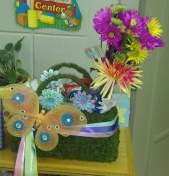
This year, I got a May Basket.  One of my students read my reminissing about May Day on our classroom website.  It totally made my day.  I was so thrilled with the sweetness of the gesture that I quickly took a picture and posted it on Facebook where I tagged all of my childhood friends.  That in turn brought comments of our days in the neighborhood and our May Baskets.  One act of kindness brought memories and happy thoughts to many!

Posted in Notes from the teacher's desk | Tagged , , , , , , , , , , , , , , , | Leave a comment

Fleas and Pets

I have two dogs.  Molly, the oldest, is a 15 year old Schnauzer with definite signs of aging. Lucy, the stray we adopted, is about 3 or 4 years old. I have a carpet that needs to be cleaned frequently and furniture that looks like a beagle fur coat but the one thing I don’t have to deal with is fleas!

My dogs don’t wear flea collars, have never had treatments or been dipped.  I attribute the lack of fleas to Autumn Sage (Salvia Greggii).

My yard is full of it.  The dogs walk through it on their daily jaunts through the backyard. They come back in the house smelling like sage and they don’t have fleas.

So I did a little research to see if my flea theory was correct.  I came across the Responsible Pet Ownership Blog which has a list of plants that naturally help fight fleas. Sage is listed as one of them, along with mint and rosemary, which are also in my garden but not in the abundance as the Autumn Sage.

One thing I like about Autumn Sage is the variety of colors that are available.  My favorite is “Lipstick” followed by apricot.  I have several white ones in my “moon garden” which only has white flowers to reflect the moonlight.  In the south, Autumn sage will bloom almost year round.  Humming birds and other nectar loving garden visitors will dart from one bush to another.  It brings a lot to the garden.

Another attractive aspect of Autumn Sage is the price.  Most nurseries will have 4″ plants for less than $5.00.  They grow quickly and in no time you have a nice 2′-3′ bush.  It can handle some shade and loves the sun.


I love my dogs!  I love my Autumn Sage!

Posted in Notes from the teacher's desk | Tagged , , , , , , , , , , , , , , | Leave a comment

Google Lit Trips

Our first grade reader has the story Lost! by David McPhail as one of the selections. During the 1st year of reading it I realized that it was set in Boston (Swan Boats was the trigger) and would be a perfect book for a Google Lit Trip (GLT).  I got busy and made my trip but made the mistake of using pictures saved on my computer.  So when the school made the switch  from PC’s to Macs, I lost most of what I had done.

It had been a long time since I had made my GLT so I had to redo some research on how to placemarks and add pictures.  Thank goodness for YouTube!  There are several good Google Lit Trip tutorials that are easy to follow.  You can also use the Lit Trip Tips but it is hard to find it on their site.

The first step towards your GLT is to download Google Earth. I use Google Earth a lot in my classroom.  This past week it was perfect for teaching street view, bird’s eye view and map view.  We visited Mystic Rock Minis outside of Oklahoma City when we read Foal, another story in our reader and were watching their barn cam.  We have taken virtual field trips to Williamsburg, Yellowstone (with our Wilson Elementary School pen pals in Wyoming), Texas, Kansas and Korea.  Next week we will be visiting several dinosaur parks when we read Dinosaur Babies and then visit lighthouses when we read The True Story of Abbie Burgess.

To start your Lit Trip, make a story board.  The advantage of doing this is that you will have all of your information in one spot.  You can see how the narrative flows and check for repetition and spelling.  When the time comes to do your placemarks, it will be easy to cut and paste the information.

I worked on my revised Lost! trip for several days during my breaks at school but the kids love them!  It becomes a different way to retell a story.  Google Lit Trips can take a lot of time to make so I would like to share it.  You can download my GLT for Lost! . You will need Google Earth to view it and if you have difficulties consult the GLT website for viewing tips.

Lost! Google Lit Trip

How to open a GLT downloaded file

When the Swan Boats were mentioned in  Lost! I was surprised to find out that my students had never read Make Way for Ducklings by Robert McCloskey. Since it is set in Boston also and one of my all time favorite books, we read it and then viewed the Make Way for Ducklings GLT (in the K-5 section) as well.  We compared and contrasted where the bear in Lost! and the Mallard family in Make Way for Ducklings went in Boston.

Time consuming to make…..yes!  Watching the children get excited about their virtual trip…..priceless!

Posted in Notes from the teacher's desk | Tagged , , , , , , , , , , , , , , , , , , , , , , | Leave a comment

Report Card Day in the Paperless World

Top 5 reasons I hate digital report cards:

1. Children aren’t handed a report card…..what is the fun in that?  Report card day used to be an important day. The anticipation of receiving it, the anticipation of opening it and the reaction when mom and dad see it!

2. Children should be given the opportunity to review the report card before their parents.  It’s the sumerization of their efforts so they should see it first.   Happy or sad, they need to know what it contains.

3.  Digital report cards miss the personalization of hand written comments.  I am probably one of the few teachers that enjoys writing comments.  I want the opportunity to say something positive.  I want to be able to encourage the child with the less than perfect report card and let the parent know that the best effort was put forward.  I want to let them know that I care, that I looked over the grades and that I didn’t just choose a cookie cutter comment from a drop down menu.

4. Do the children even get to see their digital report card?  How many parents are looking at them and not sharing the actual report card but only their reaction to what they saw?

5.  If you read my post on “Don’t Go Paperless” you saw this one coming……are the parents printing the digital report card to save in the memory box?  Grandchildren are going to want to see those…….

Yes, I understand the economics of a digital report card.  I just don’t see it in the best interest of an elementary child.  They need something a bit more tangible.

Posted in Notes from the teacher's desk | Tagged , , , , , , , | 1 Comment

Don’t Go Paperless

It’s 2012 and I am asking you, in the dawn of the world of digital storage, not to not go paperless.  I am asking you, in the age of reduce, reuse, recycle, and repurpose, not to go paperless.  I am asking you, for your child, to not go paperless.

I am not asking this because I want you to become a paper hoarder.  I am asking this so you to don’t send the wrong message to your child……..

“Your job is not important!”  

That’s right, your child has a job.  Just like you, your child gets up every morning, gets dressed and heads off to work.  They have tasks that they must complete and deadlines to meet. They work hard all day long and for some it doesn’t come easy.

Picture yourself at your job, busy during the day, to meet a deadline.   You take the finished product to your boss at the end of the day, who looks at it, tells you thanks and throws it in the trash.  Your boss sent you a message and it wasn’t a positive one.  How would you feel if this really happened to you?

Yet, there are parents out there sending this message to their children.  They are the parents not looking at their child’s school work at all or look at it and then throw it away.

I am aware that you could fill a small bedroom if you kept every piece of school work that arrives home but you owe it to your child to treat their work with respect. During their school years they spend more time at their job than they do with you.  It is a big part of their life and you should save at least a small portion of this part of their childhood.

Guilty parents, it’s not that hard to do. Make going through their work an activity that you do together.  Look at each paper.  If something is wrong, briefly go over the mistake. Find something your child did well and compliment them on it (don’t make it a time to just go through to see how many 100’s there are……look for neatness, interesting sentences,  or previous mistakes that are now correct).  Ask them what paper they are most proud of and if there are any papers or artwork they would like to keep.

After you have gone through the folder with them, don’t throw the other papers away! Many times children, especially early elementary children, will take a paper home that should have given to the teacher for assessment.  At the end of the day when the teacher starts grading work, they will realize it and will be asking you to send it back. Keep  papers for at least 2 weeks at a time.  When you do dispose of the work, don’t do it in front of your child!  Put it in a bag on trash day or in the middle of recycled newspapers.  Just don’t let them see it!

My mother saved very little of my work but what she did save was in a shirt box labeled with my name.  She saved mainly artwork and report cards.  As I got older I began saving work and adding it to the box.  I have enjoyed going through it over the years so when my children entered preschool, I started saving some of their work. I got 3 inch binders and a 3 hole punch and made books. If I was doing it now, I would use plastic bins and take more pictures of oversized artwork or projects.  I tried to keep papers that showed their development (writing name, drawing people, etc). I even managed to save, without them looking,  some samples from high school and college.   They are packed away but someday, perhaps when they have children, they will enjoy looking at them.

Do you need help getting started?  Jeri’s Organizing and Decluttering News suggests several ways to decide what to keep and what to throw away.  Most comments agree that children should be a part of the decision making process.

One commenter suggests making a digital scrapbook of artwork but that makes me a bit nervous.  You see, I remember 8 track tapes.  I’ve see the demise of the floppy diskette. How long will it be before CD’s are no longer welcomed in our computers?  Go ahead and store it on your computer, but if you value it, back it up with a paper copy.

Find a system that works for you and don’t go paperless with your child’s school work. Don’t let them think their job isn’t important.  Don’t send the wrong message. Respect your child’s work and send them the message that you respect what they do all day when they are a part from you.

Posted in Notes from the teacher's desk | Tagged , , , , , , , , , , | 2 Comments